
Science Fiction · Near-Future Thriller
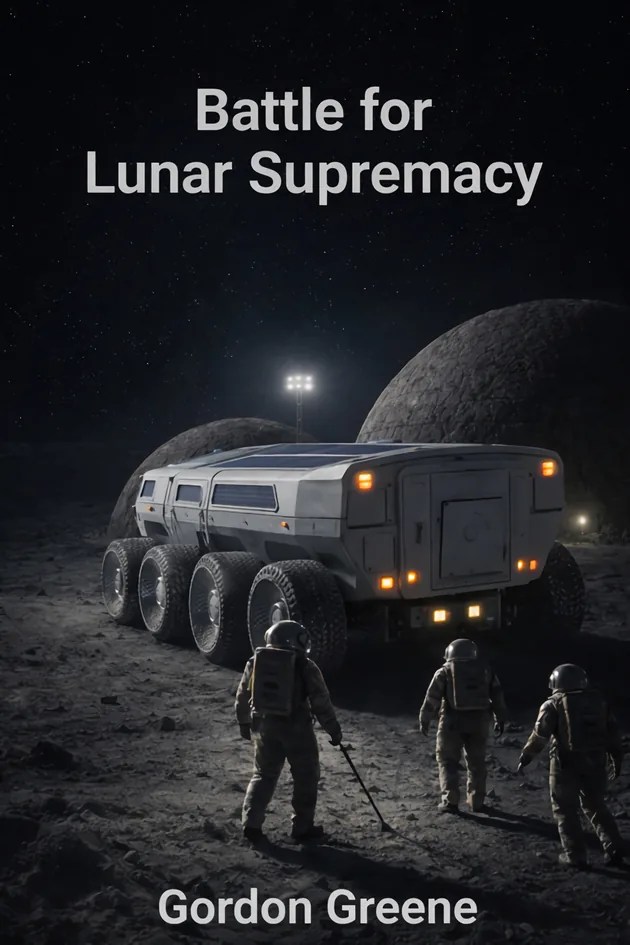
Battle for Lunar Supremacy
Chapter One — Sample
Now Available — Battle for Lunar Supremacy is available now in eBook, paperback and hardcover. The chapter below is a promotional sample. Order your copy today and join the mailing list below for news and exclusive content.
Mark Jonathan Collins woke to his alarm beeping on the nightstand beside his sleeping station. He rolled out of bed, stood, and stretched, shaking off sleep and reacquainting himself with the Moon's low gravity. Overhead lights gradually brightened in response to his movements, mimicking the dawn in a place that had never experienced one.
At forty-six, Mark Collins was the current commander of the Moon base run by the Transnational Alliance for Science and Innovation (TASI), a coalition of the United Kingdom, the European Union, Canada, Australia, and the United States. His short blond hair was streaked with gray at the temples, and his piercing gray-blue eyes were his most striking feature. Standing six feet tall, he had a lean, well-maintained build — a testament to years of discipline as a former astronaut and geologist.
Mark had just returned to the base the day before, after three weightless days aboard the Transport Shuttle from TASI's Earth-Orbiting Command Station (EOCS). The trip always left him exhausted. Even after years of rotating between Earth and the Moon, the transition still took a toll.
The meeting at EOCS was necessary due to a concerning trend emerging from one of the other two Moon-based facilities. Over several weeks, TASI observed workers from the joint Russia, China, and North Korea Moon base, known as the Tri-Nation Development Consortium (TNDC), crossing TASI's established lunar perimeter without permission. Each Moon base organization was fully aware of the perimeters surrounding the other bases. Despite being competitors, the three bases had agreed to operate within an informal quasi-partnership because working on the Moon was both dangerous and isolating. Even so, there was still a duty for the Moon bases to respect each other's border perimeters, and crossing those boundaries required prior approval from each Moon base operator.
Mark pushed his fatigue aside and moved toward the bathroom attached to his quarters. He took off his clothes, grabbed his UV goggles, and stepped into the dry-shower stall. He closed the door, and a warm blast of air hit his body from all sides. Simultaneously, a strong vacuum sucked the air from the stall, removing dust, dirt, and loose skin particles that had been dislodged. The overhead UV light shone down, killing any bacteria on his skin. He stood there for the required one minute, then the automatic timer turned off the UV light and stopped the airflow.
He stepped out of the stall, went back to his sleeping quarters, and picked out a clean uniform from the dresser. It was a one-piece baby-blue jumpsuit with M. J. Collins stitched over the left breast pocket. Once dressed, he headed to the mess hall.
The base usually housed between 40 and 60 people, including scientists, engineers, miners, medical personnel, technicians, and operational support staff. Depending on each member's role, their deployment lengths varied. Miners, who handled the most physically demanding tasks, worked on a five-week rotation. Building, vehicle maintenance, and construction crews rotated every two months, while service personnel, such as cooks, computer technicians, geologists, and other professional staff, followed a three-month schedule. The core administrative team at the base, including Mark Collins, was permanently assigned unless an early departure was necessary due to circumstances.
The three Moon bases looked very similar in design because they used the same construction process, mainly due to the high cost of shipping materials to the Moon. That said, each base was an engineering marvel. Their exteriors were made through basalt sintering, a process that heats and compresses crushed basalt rock using intense solar heat, reaching temperatures from 1,000 to 1,200 degrees Celsius. This technique creates a dense, durable, and corrosion-resistant solid without fully melting the material. The final product was ideal for forming rugged outer domes that shield the bases against radiation and micrometeorites.
Beneath the outer shell, a secondary structural layer made of a sulfur–regolith composite provides both insulation and load-bearing strength. A 70:30 regolith-to-sulfur ratio was chosen for optimal durability, then melted and mixed with small amounts of refined lunar metal powder and polymer fibers to boost tensile strength and lessen brittleness. Using precise 3D-printing systems, the molten composite was extruded to form the exact shape needed for the habitat's structural supports.
Inside the habitats, the interior walls, made from polycarbonate derived from lunar materials, divided the structure into separate modules while smoothly supporting equipment, utilities, and life-support systems essential for the crew. These inner walls also maintained the habitat's air pressure, creating a secure, adaptable environment that surprisingly felt comfortable and cozy despite the surrounding desolation. Since the material was easy to 3D-print, air ducts, cable channels, and plumbing conduits were built directly into the walls, along with molded hatches, sliding doors, and even furniture. Although each component was made for a specific purpose, the habitat still felt open and welcoming, highlighting the ingenuity of its design.
As Mark entered the mess hall, the hum of conversation greeted him. With a crew change happening today, many of those scheduled to leave the Moon base for their trip back to Earth were already seated, chatting excitedly.
He spotted Dr. Elena Rousseau, TASI's current lead geologist at the Moon base, sitting in her usual spot and checking something on her tablet. Elena was from France, thirty-eight, lean and athletic, having spent several years in fieldwork and geological expeditions. For practical reasons, she cut her dark brown hair to rest just above her shoulders. Her hazel eyes were sharp and observant, and when the lighting was just right, a slight green fleck was visible within them. Her light olive skin had subtle freckles from prolonged fieldwork in harsh sunlight. A small scar ran along her left eyebrow, a leftover from a field accident during an earlier expedition on Earth.
Walking up to where she was sitting, Mark called out to her, "Bonjour, Elena, comment ça va ce matin?"
She looked up and smiled. "Bonjour, Mark. I'm well. And you?"
"Tired," he admitted. "You'd think floating weightless for three days would be relaxing, but I always come back exhausted."
"Boredom, perhaps?" she teased.
He chuckled. "You could be right."
She set down her tablet. "How did your meeting go?"
"Everyone's on edge," he said, lowering his voice. "They're not sure what TNDC is up to, but want us to keep a close watch on their activities around our perimeter."
"Do you think they'd really try to steal from us or sabotage our equipment?"
"I don't know. But their countries have a history of taking what isn't theirs."
Elena frowned. "Up here, we're all supposed to cooperate, at least enough to keep everyone alive."
"Agreed, but it's a different mindset for them."
"So, what's the plan?" she asked, concern evident in her voice.
"They want me to have a one-on-one with Alexi to see if he might be willing to share any information."
She raised an eyebrow. "You think TNDC's base commander would be foolish enough to share their plans with you?" she asked incredulously.
"Alexi and I have a good relationship despite our commitments to our respective organizations. I'm not expecting full disclosure, but I hope to catch a hint of their current motives during our conversation."
"Will you invite him here or go there?"
"I'll ask for a meeting there. Since it's on his home turf, he might be less cautious and accidentally reveal something," he said.
Elena smiled wryly. "Then I wish you bonne chance."
"Thanks, I'll need it."
The establishment of Moon bases began with India. Rather than aligning with other nations, India decided to go it alone. It was the first to establish a Moon base at the lunar South Pole, with the goal of mining lunar minerals. Upon landing, India immediately declared a 50-kilometer perimeter around its site at Lat 88.096°S, Lon 2°E. India's base occupied the sector just east of the prime meridian, along the inner polar ring system near Shackleton crater, the Moon's most famous south polar formation.
Shackleton's rim, illuminated by grazing sunlight for much of the lunar year, rose slightly west of Purnima's site. To the east lay the broader basins leading toward Nobile and the distant Amundsen depression. The site selection was precise, targeting permanently shadowed regions (PSRs). Shackleton sat directly on the South Pole, its rim kissed by sunlight nearly year-round, while its interior remained in perpetual shadow, forming a vault of ice.
Haworth nearby expanded the reserves with a second shadowed crater — another cache of frozen resources. Ice meant air, fuel, and leverage. On the Moon, leverage meant power.
India's base, called Purnima ("Full Moon" in Sanskrit), was more than just a name — it was a statement.
To the world, the name seemed symbolic. To India, it signified permanence and a quiet assertion — not of sovereignty, which the Tribunal prohibited, but of operational control, strategic influence, and lasting presence. It reflected cultural pride and emphasized India's role as a pioneer in lunar exploration.
India's bold move forced a response, and within a year, the Tri-Nation Development Consortium (TNDC) and the Transnational Alliance for Science and Innovation (TASI) established rival bases, each rushing to secure its own sectors within weeks of each other. Neither TNDC nor TASI could afford to let India dominate the South Pole.
TNDC selected the area near Cabeus crater, located at Lat −88.096°, Lon 122°E. Their base clung to the edges of two craters filled with ice-shadowed darkness. The corridor was a vein of resources — oxygen, water, and rocket fuel awaiting extraction. The nearby ridges provided equally crucial resources: solar vantage points where energy flowed almost nonstop. For TNDC, this was more than just survival. It was a fortress, a stronghold carved into the most valuable terrain in space.
TASI, meanwhile, claimed territory near the Kocher and Kuhn crater complex, with Sverdrup and de Gerlache craters not far from its logistical corridors. Located at Lat −88.096°, Lon 242°E, their strategy depended on diversification, and their claim extended into one of the Moon's darkest regions. Although the crater rims in this region receive periodic sunlight, the interior floors of the Kuhn crater complex often remain in permanent or prolonged shadow, preventing them from getting direct sunlight. But TASI's planners recognized a network. By spreading their reach across multiple PSR clusters, they ensured that even if one area dried up, their mission could continue. Sverdrup and de Gerlache had rims bathed in sunlight for nearly ninety percent of the year. From its heights, TASI could power its base indefinitely, casting light over the shadows it mined below.
What initially began as exploration evolved into a different reality. Confronted with India's unilateral 50-kilometer perimeter standard, what was once exploration turned into a struggle for control. The South Pole ceased to be a frontier; it became a battleground — silent, airless, and perilous.
Shackleton, Haworth, Sverdrup, de Gerlache, Cabeus — these names no longer belonged to maps or scientific articles. They had become strongholds, outposts in a struggle that no treaty could contain, because lunar mining remained unresolved even after a 1979 attempt to establish an agreement. Known officially as the Agreement Governing the Activities of States on the Moon and Other Celestial Bodies, the Moon Agreement was an international treaty that regarded the Moon and its resources as the "common heritage of mankind," thereby banning their use for military purposes, exploitation, and private ownership. Despite its good intentions, the treaty failed to gain widespread acceptance because major spacefaring nations, including the United States, Russia, and China, did not ratify it. This failure ultimately reduced the effectiveness of its guidelines under international law. And with India's initial landing at the South Pole, the game had begun.
© Gordon Greene. All rights reserved. This excerpt is provided for promotional purposes only.
Stay in the Story
Join the mailing list for news, exclusive content, and upcoming releases.
Join the Mailing List